In search of the best AI resume builder? An AI resume builder is software that uses machine learning to help you get more done — it turns a rough idea into a polished result in seconds. When choosing one, weigh output quality, pricing, export formats, and how well it fits the tools you already use. Whether you are a beginner or a pro, the right AI resume builder slots into your workflow and pays for itself fast. We tested the leading options and ranked them by quality, value, and ease of use.
Security switch
A security switch is a hardware device designed to protect computers, laptops, smartphones and similar devices from unauthorized access or operation, distinct from a virtual security switch which offers software protection. Security switches should be operated by an authorized user only; for this reason, it should be isolated from other devices, in order to prevent unauthorized access, and it should not be possible to bypass it, in order to prevent malicious manipulation. The primary purpose of a security switch is to provide protection against surveillance, eavesdropping, malware, spyware, and theft of digital devices. Unlike other protections or techniques, a security switch can provide protection even if security has already been breached, since it does not have any access from other components and is not accessible by software. It can additionally disconnect or block peripheral devices, and perform "man in the middle" operations. A security switch can be used for human presence detection since it can only be initiated by a human operator. It can also be used as a firewall. == Types == === Hardware kill switch === A hardware kill switch (HKS) is a physical switch that cuts the signal or power line to the device or disable the chip running them. == Examples == A cellphone is compromised by malicious software, and the device initiates video and audio recording. When the user activates the “prevent capture of audio/video” mode of the security switch, that either physically disconnects or cut the power to the microphone and the camera, which stops the recording. A laptop that has an embedded security switch is stolen. The security switch detects a lack of communication from a specific external source for 12 hours, and responds by disconnecting the screen, keyboard and other key components, rendering the laptop useless, with no possibility of recovery, even with a full format. A user wishes to prevent tracking of their location. The user then activates geolocation protection and the security switch disables all GPS communication, eliminating the possibility of tracking the device's location. A user desires to eliminate the possibility of their PIN being copied from their smartphone. They can activate the secure input function, causing the security switch to disconnect the touch screen from the operating system, so input signals are not available to any devices except the switch. A security switch performs scheduled monitoring and finds that a program is attempting to download malicious content from the internet. It then activates internet security function and disables internet access, interrupting the download. If laptop software is compromised by air-gap malware, the user may activate the security switch and disconnect the speaker and microphone, so it can not establish communication with the device. == History == Google started to work on a hardware kill switch for AI in 2016. In 2019, Apple, and Google, along with a handful of smaller players, are designing “kill switches” that cut the power to the microphones or cameras in their devices. Googles first product that implemented this is Nest Hub Max. Hardware kill switches are already available and widely tested on the PinePhone, Librem, Shiftphone, to cut power to the input peripherals (microphone, camera) but also the network connectivity modules (wifi, cellular network).
Alice AI (AI model family)
Alice AI is a neural network family developed by the Russian company Yandex LLC. Alice AI can create and revise texts, generate new ideas and capture the context of the conversation with the user. Alice AI is trained using a dataset which includes information from books, magazines, newspapers and other open sources available on the internet. The neural network may get facts wrong and hallucinate, but as it learns, it will produce increasingly accurate answers. == Usage == YandexGPT is integrated into virtual assistant Alice (an analog of Siri and Alexa) and is available in Yandex services and applications. The company gives businesses access to the neural network’s API through the public cloud platform Yandex Cloud and develops its own B2B solutions on its basis. Since July 2023, 800 companies have participated in the closed testing of YandexGPT. IT developers, banks, retail businesses, and companies from other industries can use the technology in two modes — API and Playground (an interface in the Yandex Cloud console for testing models and hypotheses). Two model versions are available to businesses: one works in asynchronous mode and is better able to handle complex tasks, while the other is suitable for creating quick responses in real time. As a result, YandexGPT has been tested in dozens of scenarios such as content tasks, tech support, creating chatbots, virtual assistants, etc. == History == In February 2023, Yandex announced that it was working on its own version of the ChatGPT generative neural network while developing a language model from the YaLM (Yet another Language Model) family. The project was tentatively named YaLM 2.0, which was later changed to YandexGPT. On May 17, the company unveiled a neural network called YandexGPT (YaGPT) and enabled its virtual assistant Alice to interact with the new language model. On June 15, 2023, Yandex added the YandexGPT language model to the image generation application Shedevrum. This enabled its users to create fully-fledged posts complete with a title, text, and relevant illustration. In July 2023, YandexGPT launched new features enabling businesses to create virtual assistants and chatbots, as well as generate and structure texts. On September 7, 2023, Yandex presented a new version of the language model, YandexGPT 2, at the Practical ML Conf. Compared to the previous one, the new version is able to perform more types of tasks, and the quality of answers has improved. The developers claimed that YandexGPT 2 answered user questions better than the first version in 67% of cases. From October 6, 2023, YandexGPT can create short retellings of online Russian-language videos on the Internet. It can summarize videos that are from two minutes to four hours long and contain speech.
Eigenmoments
EigenMoments is a set of orthogonal, noise robust, invariant to rotation, scaling and translation and distribution sensitive moments. Their application can be found in signal processing and computer vision as descriptors of the signal or image. The descriptors can later be used for classification purposes. It is obtained by performing orthogonalization, via eigen analysis on geometric moments. == Framework summary == EigenMoments are computed by performing eigen analysis on the moment space of an image by maximizing signal-to-noise ratio in the feature space in form of Rayleigh quotient. This approach has several benefits in Image processing applications: Dependency of moments in the moment space on the distribution of the images being transformed, ensures decorrelation of the final feature space after eigen analysis on the moment space. The ability of EigenMoments to take into account distribution of the image makes it more versatile and adaptable for different genres. Generated moment kernels are orthogonal and therefore analysis on the moment space becomes easier. Transformation with orthogonal moment kernels into moment space is analogous to projection of the image onto a number of orthogonal axes. Nosiy components can be removed. This makes EigenMoments robust for classification applications. Optimal information compaction can be obtained and therefore a few number of moments are needed to characterize the images. == Problem formulation == Assume that a signal vector s ∈ R n {\displaystyle s\in {\mathcal {R}}^{n}} is taken from a certain distribution having correlation C ∈ R n × n {\displaystyle C\in {\mathcal {R}}^{n\times n}} , i.e. C = E [ s s T ] {\displaystyle C=E[ss^{T}]} where E[.] denotes expected value. Dimension of signal space, n, is often too large to be useful for practical application such as pattern classification, we need to transform the signal space into a space with lower dimensionality. This is performed by a two-step linear transformation: q = W T X T s , {\displaystyle q=W^{T}X^{T}s,} where q = [ q 1 , . . . , q n ] T ∈ R k {\displaystyle q=[q_{1},...,q_{n}]^{T}\in {\mathcal {R}}^{k}} is the transformed signal, X = [ x 1 , . . . , x n ] T ∈ R n × m {\displaystyle X=[x_{1},...,x_{n}]^{T}\in {\mathcal {R}}^{n\times m}} a fixed transformation matrix which transforms the signal into the moment space, and W = [ w 1 , . . . , w n ] T ∈ R m × k {\displaystyle W=[w_{1},...,w_{n}]^{T}\in {\mathcal {R}}^{m\times k}} the transformation matrix which we are going to determine by maximizing the SNR of the feature space resided by q {\displaystyle q} . For the case of Geometric Moments, X would be the monomials. If m = k = n {\displaystyle m=k=n} , a full rank transformation would result, however usually we have m ≤ n {\displaystyle m\leq n} and k ≤ m {\displaystyle k\leq m} . This is specially the case when n {\displaystyle n} is of high dimensions. Finding W {\displaystyle W} that maximizes the SNR of the feature space: S N R t r a n s f o r m = w T X T C X w w T X T N X w , {\displaystyle SNR_{transform}={\frac {w^{T}X^{T}CXw}{w^{T}X^{T}NXw}},} where N is the correlation matrix of the noise signal. The problem can thus be formulated as w 1 , . . . , w k = a r g m a x w w T X T C X w w T X T N X w {\displaystyle {w_{1},...,w_{k}}=argmax_{w}{\frac {w^{T}X^{T}CXw}{w^{T}X^{T}NXw}}} subject to constraints: w i T X T N X w j = δ i j , {\displaystyle w_{i}^{T}X^{T}NXw_{j}=\delta _{ij},} where δ i j {\displaystyle \delta _{ij}} is the Kronecker delta. It can be observed that this maximization is Rayleigh quotient by letting A = X T C X {\displaystyle A=X^{T}CX} and B = X T N X {\displaystyle B=X^{T}NX} and therefore can be written as: w 1 , . . . , w k = a r g m a x x w T A w w T B w {\displaystyle {w_{1},...,w_{k}}={\underset {x}{\operatorname {arg\,max} }}{\frac {w^{T}Aw}{w^{T}Bw}}} , w i T B w j = δ i j {\displaystyle w_{i}^{T}Bw_{j}=\delta _{ij}} === Rayleigh quotient === Optimization of Rayleigh quotient has the form: max w R ( w ) = max w w T A w w T B w {\displaystyle \max _{w}R(w)=\max _{w}{\frac {w^{T}Aw}{w^{T}Bw}}} and A {\displaystyle A} and B {\displaystyle B} , both are symmetric and B {\displaystyle B} is positive definite and therefore invertible. Scaling w {\displaystyle w} does not change the value of the object function and hence and additional scalar constraint w T B w = 1 {\displaystyle w^{T}Bw=1} can be imposed on w {\displaystyle w} and no solution would be lost when the objective function is optimized. This constraint optimization problem can be solved using Lagrangian multiplier: max w w T A w {\displaystyle \max _{w}{w^{T}Aw}} subject to w T B w = 1 {\displaystyle {w^{T}Bw}=1} max w L ( w ) = max w ( w T A w − λ w T B w ) {\displaystyle \max _{w}{\mathcal {L}}(w)=\max _{w}(w{T}Aw-\lambda w^{T}Bw)} equating first derivative to zero and we will have: A w = λ B w {\displaystyle Aw=\lambda Bw} which is an instance of Generalized Eigenvalue Problem (GEP). The GEP has the form: A w = λ B w {\displaystyle Aw=\lambda Bw} for any pair ( w , λ ) {\displaystyle (w,\lambda )} that is a solution to above equation, w {\displaystyle w} is called a generalized eigenvector and λ {\displaystyle \lambda } is called a generalized eigenvalue. Finding w {\displaystyle w} and λ {\displaystyle \lambda } that satisfies this equations would produce the result which optimizes Rayleigh quotient. One way of maximizing Rayleigh quotient is through solving the Generalized Eigen Problem. Dimension reduction can be performed by simply choosing the first components w i {\displaystyle w_{i}} , i = 1 , . . . , k {\displaystyle i=1,...,k} , with the highest values for R ( w ) {\displaystyle R(w)} out of the m {\displaystyle m} components, and discard the rest. Interpretation of this transformation is rotating and scaling the moment space, transforming it into a feature space with maximized SNR and therefore, the first k {\displaystyle k} components are the components with highest k {\displaystyle k} SNR values. The other method to look at this solution is to use the concept of simultaneous diagonalization instead of Generalized Eigen Problem. === Simultaneous diagonalization === Let A = X T C X {\displaystyle A=X^{T}CX} and B = X T N X {\displaystyle B=X^{T}NX} as mentioned earlier. We can write W {\displaystyle W} as two separate transformation matrices: W = W 1 W 2 . {\displaystyle W=W_{1}W_{2}.} W 1 {\displaystyle W_{1}} can be found by first diagonalize B: P T B P = D B {\displaystyle P^{T}BP=D_{B}} . Where D B {\displaystyle D_{B}} is a diagonal matrix sorted in increasing order. Since B {\displaystyle B} is positive definite, thus D B > 0 {\displaystyle D_{B}>0} . We can discard those eigenvalues that large and retain those close to 0, since this means the energy of the noise is close to 0 in this space, at this stage it is also possible to discard those eigenvectors that have large eigenvalues. Let P ^ {\displaystyle {\hat {P}}} be the first k {\displaystyle k} columns of P {\displaystyle P} , now P T ^ B P ^ = D B ^ {\displaystyle {\hat {P^{T}}}B{\hat {P}}={\hat {D_{B}}}} where D B ^ {\displaystyle {\hat {D_{B}}}} is the k × k {\displaystyle k\times k} principal submatrix of D B {\displaystyle D_{B}} . Let W 1 = P ^ D B ^ − 1 / 2 {\displaystyle W_{1}={\hat {P}}{\hat {D_{B}}}^{-1/2}} and hence: W 1 T B W 1 = ( P ^ D B ^ − 1 / 2 ) T B ( P ^ D B ^ − 1 / 2 ) = I {\displaystyle W_{1}^{T}BW_{1}=({\hat {P}}{\hat {D_{B}}}^{-1/2})^{T}B({\hat {P}}{\hat {D_{B}}}^{-1/2})=I} . W 1 {\displaystyle W_{1}} whiten B {\displaystyle B} and reduces the dimensionality from m {\displaystyle m} to k {\displaystyle k} . The transformed space resided by q ′ = W 1 T X T s {\displaystyle q'=W_{1}^{T}X^{T}s} is called the noise space. Then, we diagonalize W 1 T A W 1 {\displaystyle W_{1}^{T}AW_{1}} : W 2 T W 1 T A W 1 W 2 = D A {\displaystyle W_{2}^{T}W_{1}^{T}AW_{1}W_{2}=D_{A}} , where W 2 T W 2 = I {\displaystyle W_{2}^{T}W_{2}=I} . D A {\displaystyle D_{A}} is the matrix with eigenvalues of W 1 T A W 1 {\displaystyle W_{1}^{T}AW_{1}} on its diagonal. We may retain all the eigenvalues and their corresponding eigenvectors since most of the noise are already discarded in previous step. Finally the transformation is given by: W = W 1 W 2 {\displaystyle W=W_{1}W_{2}} where W {\displaystyle W} diagonalizes both the numerator and denominator of the SNR, W T A W = D A {\displaystyle W^{T}AW=D_{A}} , W T B W = I {\displaystyle W^{T}BW=I} and the transformation of signal s {\displaystyle s} is defined as q = W T X T s = W 2 T W 1 T X T s {\displaystyle q=W^{T}X^{T}s=W_{2}^{T}W_{1}^{T}X^{T}s} . === Information loss === To find the information loss when we discard some of the eigenvalues and eigenvectors we can perform following analysis: η = 1 − t r a c e ( W 1 T A W 1 ) t r a c e ( D B − 1 / 2 P T A P D B − 1 / 2 ) = 1 − t r a c e ( D B ^ − 1 / 2 P ^ T A P ^ D B ^ − 1 / 2 ) t r a c e ( D B − 1 / 2 P T A P D B − 1 / 2 ) {\displaystyle {\begin{array}{lll}\eta &=&
Robot Monk Xian'er
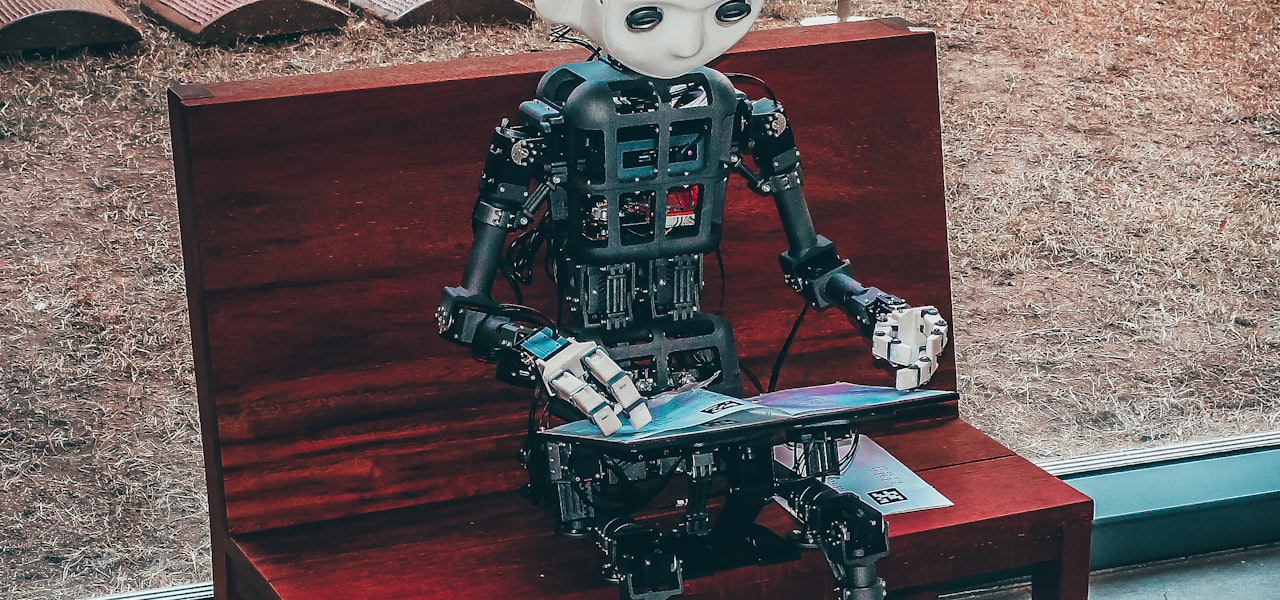
Robot Monk Xian'er (Chinese: 贤二机器僧) is a humanoid robot based on the cartoon character Xian'er. It was developed by a team of monks, volunteers and AI experts from Beijing Longquan Monastery in Beijing, China. He can follow human instructions to make body movements, read scriptures and play Buddhist music. He can chat and respond to people's emotional and spiritual questions with Buddhist wisdom. As a chatbot, Robot Monk Xian'er is available on certain public platforms including WeChat and Facebook. Over the years, master Xuecheng, the abbot of Beijing Longquan Monastery, replied to thousands of questions on Sina Weibo. These questions and their answers become the data source of the chatbot.
Taimi
Taimi ( TAY-mee) is a dating app that caters to the LGBTQI+ community. The network matches its registered users based on their selected preferences and location. Originally an online dating service for gay men, by 2022 Taimi had become an app for all members of the LGBTQI+ community. It operates in more than 138 countries, including the US, UK, the Netherlands, Spain, Central and South America, Ukraine, and other European and Asian countries. Taimi runs on iOS and Android. The mobile app has a free and subscription-based premium version and offers a number of services for communication, including live streaming, chatting, and video calling. There is also an active blog that regularly posts articles and news about events of interest to the LGBTQ+ community. The application does not provide for non-Google e-mail log option, either phone number or Facebook account, during the registration process. The data controller for the non EU/UK users is based in a company, called Social Impact Inc., with its registered address at 1180 North Town Center Drive Suite 100, Las Vegas, Nevada, 89144, United States of America. == History == Taimi was launched in 2017 by Social Impact, Inc. in Las Vegas. Its founder, Alex Pasykov, originally called the app "Tame Me," a name that gradually morphed into Taimi. Over time, Taimi expanded into other countries, and expanding its reach to the LGBTQ+ community, so that, by 2022, it was fully inclusive of the entire queer community. In November 2020 the app was redesigned, with a new interface, branding, and logo. As of 2024, there are over 25 million registered users of Taimi worldwide. Pasykov states that he is an ally of the LGBTQ+ community and that he is focused on, among other things, partnering with NGOs to fight Homophobia and "regressive policies and laws" that negatively impact the community. == Features == Users register on the app and complete a profile, including personal information and preferences for compatibility, dating style, and relationship goals. An algorithm then finds and presents recommendations that a user accepts or rejects. Users are then free to chat via text or video with people they have connected with. Safety and security features include a two-step authentication process and an automated account verification along with a clear reporting system when breaches or policy violations occur. User responses to new features and policies drive changes and modifications that are made to all aspects of the site. == Partnerships and Collaborations == Taimi has a long history of collaborations and partnerships in Pride events, both in the US and abroad, including fund-raising efforts. Taimi has partnered with Rakuten Viber to create a bot focused on educating its members on key LGBTQ+ topics and to allow queer Viber users to connect. In 2023, Taimi collaborated with the Known Agency in an "America the Beautiful" campaign to shine a spotlight on current anti-LGBTQ+ policies and laws in a number of US states, and to counter these by highlighting the values and freedoms upon which America was founded. The campaign was nominated for The Drum Awards in the category "OOH For Good" and honored with the ANA Multicultural Excellence Award. Taimi also partnered with Goodparts, a queer-owned and operated retailer, in a "Body Beautiful" campaign focused on love and acceptance of all body types. In this campaign, well-known LGBTQ+ artists are providing artwork for Goodpart's product packaging. From October 31 to December 13, 2023, Taimi showed the "Taimi Moments" video, created in collaboration with Raygun Agency, on large screens between performances of LGBTQ+ artists Doja Cat, Ice Spice, and Doechii on their Scarlet Tour. In spring 2024, Taimi launched Queer Paradise, a series of live events in Southern California to celebrate diversity, sexual exploration, and dating fluidity. Each event in the series was curated to give the full spectrum of groups within the LGBTQ+ community a space to express their authentic selves. Taimi's partners for Queer Paradise include Hawtmess Productions, Eden Entertainment Group, Hump Events, Girls Gays & Theys, Damn Good Dyke Nights, and Gaybors Agency. In summer 2024, with support from GLAAD, Taimi has updated features and self-expression tools to better serve the LGBTQ+ people seeking connection in the app. Taimi allowed members to select multiple sexualities, unified the list of sexualities across all genders, added more pronoun options, and created a more inclusive and improved list of subcategories for non-binary users. Also, in summer 2024, Taimi has partnered with gender-affirming underwear brand Urbody to release a capsule collection. Focused on gender inclusivity and sexual fluidity, the capsule collection includes a range of underwear and compression tops intended to promote "joy, self-love and empowerment."
Association for Computational Linguistics
The Association for Computational Linguistics (ACL) is a scientific and professional organization for people working on natural language processing. Its namesake conference is one of the primary high impact conferences for natural language processing research, along with EMNLP. The conference is held each summer in locations where significant computational linguistics research is carried out. It was founded in 1962, originally named the Association for Machine Translation and Computational Linguistics (AMTCL). It became the ACL in 1968. The ACL has a European (EACL), a North American (NAACL), and an Asian (AACL) chapter. == History == The ACL was founded in 1962 as the Association for Machine Translation and Computational Linguistics (AMTCL). The initial membership was about 100. In 1965, the AMTCL took over the journal Mechanical Translation and Computational Linguistics. This journal was succeeded by many other journals: the American Journal of Computational Linguistics (1974–1978, 1980–1983), and then Computational Linguistics (1984–present). Since 1988, the journal has been published for the ACL by MIT Press. The annual meeting was first held in 1963 in conjunction with the Association for Computing Machinery National Conference. The annual meeting was, for a long time, relatively informal and did not publish anything longer than abstracts. By 1968, the society took on its current name, the Association for Computational Linguistics (ACL). The publication of the annual meeting's Proceedings of the ACL began in 1979 and gradually matured into its modern form. Many of the meetings were held in conjunction with the Linguistic Society of America, and a few with the American Society for Information Science and the Cognitive Science Society. The United States government sponsored much research from 1989 to 1994, characterized by an increase in author retention rates and an increase in research in some key topics, such as speech recognition, in ACL. By the 21st century, it was able to maintain authors at a high rate who coalesced in a more stable arrangement around individual research topics. In 1991, the group published a prototype for a text generator based on the universal grammar theory of Noam Chomsky. The system, nicknamed Parrot, relied on a finite set of syntactic transformations and a hand-curated lexicon. Despite some initial success, including experimentation with morpheme syntactics, funding halted after the research team encountered intractable difficulties with inflection and abstract locutions. == Annual Meeting of the ACL == Every year, the ACL holds the Annual Meeting of the ACL. The location lies in Europe in years zero modulo three, North America in years one modulo three, and Asia–Australia in years two modulo three. In 2020, the Annual Meeting received for the first time more submissions from China than the United States. == Activities == The ACL organizes several of the top conferences and workshops in the field of computational linguistics and natural language processing. These include: Annual Meeting of the Association for Computational Linguistics (ACL), the flagship conference of the organization Empirical Methods in Natural Language Processing (EMNLP) International Joint Conference on Natural Language Processing (IJCNLP), held jointly one of the other conferences on a rotating basis Conference on Computational Natural Language Learning (CoNLL) Lexical and Computational Semantics and Semantic Evaluation (SemEval) Joint Conference on Lexical and Computational Semantics (SEM) Workshop on Statistical Machine Translation (WMT) Besides conferences, the ACL also sponsors the journals Computational Linguistics and Transactions of the Association for Computational Linguistics (TACL). Papers and other presentations at ACL and ACL-affiliated venues are archived online in the open-access ACL Anthology. == Special Interest Groups == ACL has a large number of Special Interest Groups (SIGs), focusing on specific areas of natural language processing. Some current SIGs within ACL are: == Presidents == Each year, the ACL elects a distinguished computational linguist who becomes vice-president of the organization in the next calendar year and president one year later. Recent ACL presidents are: